
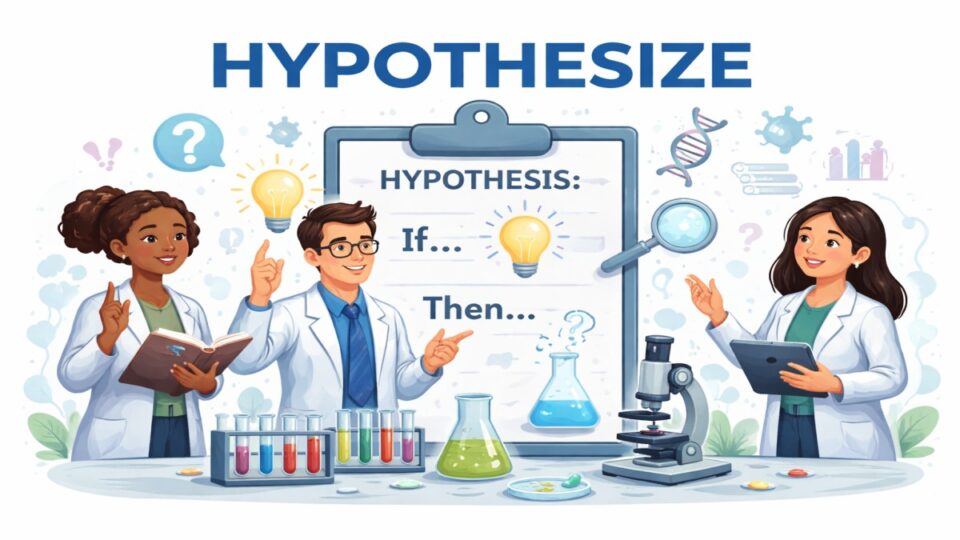
Hypothesizing. Every great discovery started with a simple thought: “What if?” That’s hypothesizing in action. Whether you’re a scientist in a lab or someone wondering why your phone battery drains so fast, hypothesizing is part of how humans understand the world.
It’s not about wild guessing—it’s about smart thinking backed by observation.
What Is Hypothesizing?
Simple Definition
Hypothesizing is the process of forming a hypothesis, which is an educated assumption or explanation that can be tested through observation or experimentation.
In plain terms, it’s saying:
“I think this happens because of that—and here’s how we can check.”
Hypothesis vs Guess
A guess is random. A hypothesis is informed.
If you flip a coin and say “heads,” that’s a guess. If you notice it lands heads more often when flipped a certain way and suggest a reason—that’s a hypothesis.
The Purpose of Hypothesizing
Why Humans Hypothesize Naturally
Our brains are pattern machines. We constantly look for cause and effect:
- Why did it rain?
- Why did sales drop?
- Why does this medicine work?
Hypothesizing helps us move from confusion to clarity.
Hypothesizing in Science
Scientific Method Explained
In science, hypothesizing is a formal step in the scientific method:
- Observe
- Ask a question
- Form a hypothesis
- Test it
- Analyze results
No hypothesis, no experiment.
Role of Hypotheses in Experiments
A hypothesis gives experiments direction. It’s like a GPS—without it, you’re just driving around collecting data with no destination.
Types of Hypotheses
Null Hypothesis
The null hypothesis assumes no effect or no relationship.
Example: “This fertilizer does not affect plant growth.”
Alternative Hypothesis
The alternative hypothesis suggests there is an effect or relationship.
Example: “This fertilizer increases plant growth.”
Science tests both to find the truth.
Hypothesizing in Everyday Life
You don’t need a lab coat to hypothesize.
Examples:
- “If I sleep earlier, I’ll feel better tomorrow.”
- “If I take a different route, I’ll avoid traffic.”
- “If I study more, my grades will improve.”
We test these ideas daily—sometimes without realizing it.
Steps in the Hypothesizing Process
Observation
Everything starts with noticing something unusual or interesting.
Question Formation
You ask why or how something happens.
Testing the Hypothesis
This is where evidence comes in—experiments, research, or real-world trials.
A hypothesis that can’t be tested isn’t very useful.
Good vs Bad Hypotheses
A good hypothesis is:
- Clear
- Specific
- Testable
- Based on observation
A bad hypothesis is vague, emotional, or impossible to test.
Think of a hypothesis like a bridge—it must be strong enough to carry evidence across.
Common Mistakes When Hypothesizing
- Confusing opinions with evidence
- Making hypotheses too broad
- Ignoring conflicting data
- Refusing to revise ideas
Good hypothesizing stays flexible. If the facts change, so should the hypothesis.
Hypothesizing in Education
Teachers encourage hypothesizing to build curiosity and problem-solving skills. It teaches students how to think, not what to think.
That skill sticks for life.
Why Hypothesizing Improves Critical Thinking
Hypothesizing trains the brain to:
- Analyze patterns
- Question assumptions
- Evaluate evidence
- Think logically
It turns passive learners into active thinkers.
Conclusion
Hypothesizing is the engine behind discovery, learning, and innovation. It transforms observations into ideas and ideas into understanding. Whether in science, school, or everyday decisions, the ability to form and test hypotheses helps us make sense of a complex world.
In short, hypothesizing isn’t just a scientific tool—it’s a life skill.
FAQs
1. Is a hypothesis always correct?
No. It’s meant to be tested, not assumed true.
2. Can you have more than one hypothesis?
Yes, especially in complex studies.
3. Is hypothesizing only used in science?
No, it’s used in daily life, business, and education.
4. What makes a hypothesis testable?
It must be measurable and observable.
5. Can a hypothesis change?
Absolutely. New evidence often leads to better hypotheses.
