
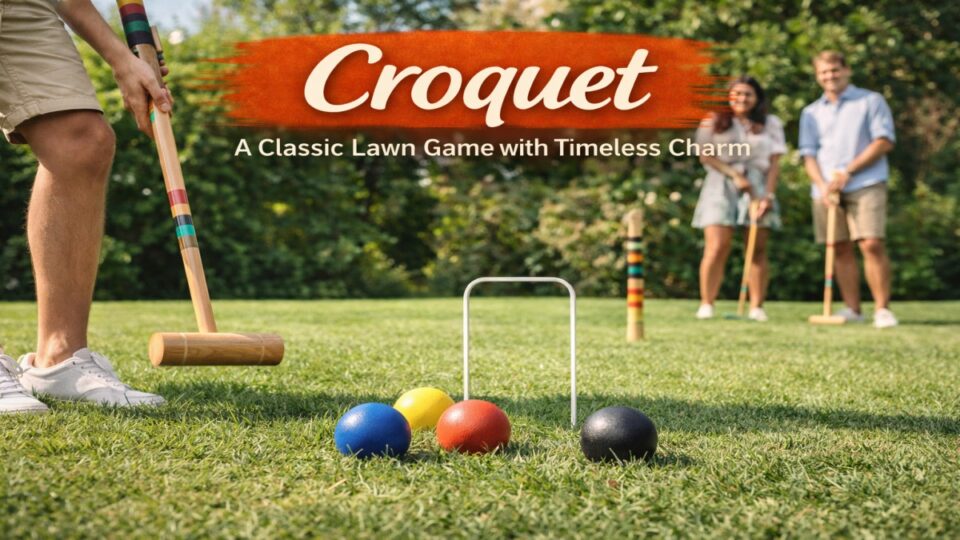
Introduction to Croquet
Some games shout for attention, while others quietly invite you in. Croquet belongs to the second category. Played on lush green lawns with wooden mallets and colorful balls, croquet is calm, strategic, and surprisingly competitive. It’s the kind of game that looks gentle on the surface but keeps your brain fully switched on.
What Is Croquet?
At its core, croquet is a lawn game where players hit balls through a series of hoops using a mallet. Sounds simple, right? But here’s the twist: every shot requires planning, precision, and sometimes a bit of clever mind play. It’s chess on grass, with sunshine and fresh air thrown in.
Why Croquet Still Matters Today
In a fast-paced digital world, croquet offers something rare—slow enjoyment. It brings people together, encourages conversation, and rewards thoughtful play rather than speed. That’s exactly why it’s still loved across generations.
The History of Croquet
Origins of the Game
Croquet’s roots trace back to 19th-century Europe, with strong ties to France and England. It evolved from older mallet games and quickly became popular among the British upper class. Lawns turned into social arenas, and croquet became a symbol of leisure and elegance.
Croquet’s Rise in Popularity
By the Victorian era, croquet was everywhere—from garden parties to royal lawns. It crossed borders, reached America, and eventually spread worldwide, adapting to local cultures along the way.
Understanding the Basics of Croquet
Croquet Equipment Explained
To play croquet, you need:
- A wooden or composite mallet
- Balls (each player has a unique color)
- Hoops (also called wickets)
- A peg (placed at the center or end)
Simple tools, endless possibilities.
The Croquet Court and Setup
A croquet court is usually a rectangular grass field, but casual games don’t demand perfection. Hoops are arranged in a specific order, forming the path each ball must follow to score points.
Understanding Hoops, Balls, and Peg
Each hoop you pass earns you progress. Hit the peg at the right moment, and you’re close to victory. Miss your shot? That’s where strategy—and patience—come in.
Rules of Croquet
Basic Rules for Beginners
Players take turns hitting their ball through hoops in the correct sequence. You earn extra shots by:
- Passing through a hoop
- Striking another ball (called a “roquet”)
It’s not just about your move—it’s about setting up your next one.
Scoring and Turns
Every hoop cleared counts toward your score. The goal is to complete all hoops and hit the peg before your opponents do.
Common Rule Variations
Different regions play with slightly different rules. That’s part of croquet’s charm—it adapts easily, whether you’re playing casually or competitively.
Types of Croquet Games
Association Croquet
This is the most formal version, played in international competitions. It’s strategic, technical, and deeply satisfying for serious players.
Golf Croquet
Faster and more accessible, golf croquet focuses on winning individual hoops rather than long turns. It’s ideal for beginners.
Backyard Croquet
This is the relaxed version most people know. Fewer rules, more laughter, and perfect for family gatherings.
Skills Needed to Play Croquet
Strategy and Precision
Croquet isn’t about brute force. It’s about angles, positioning, and foresight. One good shot can set up three future moves.
Patience and Focus
Rushing never pays off. Croquet teaches you to slow down, think ahead, and stay calm—even when the game gets tense.
Croquet as a Social Game
Croquet in Family Gatherings
Croquet shines at picnics, garden parties, and reunions. All ages can play together, making it a rare truly inclusive game.
Croquet Clubs and Competitions
Across the world, croquet clubs keep the tradition alive. Competitive matches add excitement while preserving the game’s friendly spirit.
Health and Mental Benefits of Croquet
Physical Benefits
Walking, swinging, and bending keep the body gently active. It’s low-impact but still beneficial, especially for older players.
Mental and Social Benefits
Croquet sharpens the mind, improves focus, and encourages social interaction. It’s therapy disguised as a game.
Conclusion
Croquet is more than a lawn game—it’s an experience. It blends strategy with relaxation, competition with conversation. Whether you play seriously or casually, croquet offers something rare: joy without rush. If you’ve never tried it, maybe it’s time to pick up a mallet and let the game surprise you.
FAQs
1. Is croquet hard to learn?
Not at all. Basic rules are easy, and you can enjoy the game from day one.
2. Can children play croquet?
Yes, croquet is family-friendly and suitable for all ages.
3. How long does a croquet game last?
It can range from 30 minutes to a few hours, depending on the format.
4. Do I need a perfect lawn to play croquet?
No, any reasonably flat grassy area works for casual play.
5. Is croquet a competitive sport?
Yes, croquet has international tournaments and professional players.
