
Introduction to Bee Wings
What Makes Bee Wings Unique
Bee wings are among nature’s most remarkable engineering feats. Thin, translucent, and intricately veined, they allow bees to perform their iconic buzzing flights with incredible agility. Unlike birds or bats, bee wings are lightweight yet strong, perfectly optimized for rapid, sustained movement.
Importance of Wings in Bee Life
Without wings, bees couldn’t forage for nectar, pollinate plants, or defend their hives. Wings are central to almost every aspect of a bee’s survival, from finding food to maintaining the hive temperature.
Anatomy of Bee Wings
Forewings and Hindwings
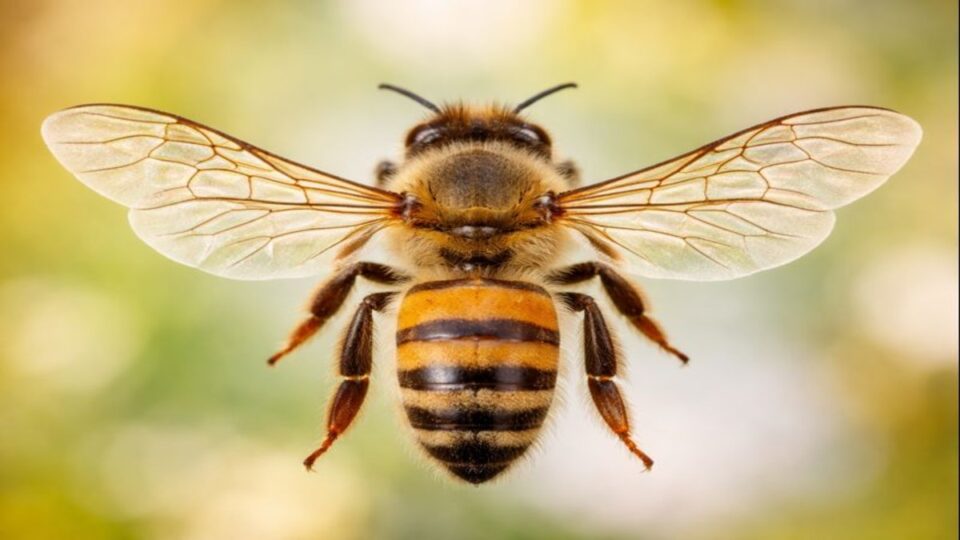
Bees have two pairs of wings: larger forewings and smaller hindwings. The hindwings attach to the forewings via a tiny set of hooks called hamuli, which allow the wings to move in unison.
Wing Veins and Membranes
Bee wings are made of thin membranes supported by a network of veins. These veins provide strength and flexibility, acting like a built-in framework for aerodynamic efficiency.
How Wing Structure Supports Flight
The combination of lightweight membranes, rigid veins, and paired wing hooks enables bees to perform rapid flapping—around 200 beats per second in honey bees—allowing hovering, sharp turns, and precise landings on flowers.
The Physics of Bee Flight
Flapping Frequency
Bees flap their wings at astonishing speeds. This rapid motion generates enough lift to support their bodies, even though their wing-to-body ratio is much smaller than in birds.
Lift and Aerodynamics
Contrary to the old myth that bees “shouldn’t be able to fly,” their flight relies on complex aerodynamics. Tiny vortices created by wing flapping increase lift and stability.
Myths About Bee Flight
The classic myth that bees defy physics isn’t true; modern studies confirm that wing motion, flapping angle, and rapid vibrations make flight entirely possible and efficient.
How Bees Use Their Wings
Flight and Foraging
Wings allow bees to travel several kilometers in search of nectar and pollen, visiting hundreds of flowers in a single day. Their precision flight is key to effective pollination.
Thermoregulation
Bees also use wing motion to regulate hive temperature. By fanning their wings, they cool the hive during hot days or circulate heat when it’s cold.
Communication through Wing Movements
During the famous waggle dance, bees use subtle wing vibrations to communicate the location of food sources to hive mates.
Bee Wing Variations Among Species
Honey Bees
Honey bee wings are streamlined for endurance and speed. Their synchronized flapping allows for extended foraging trips.
Bumblebees
Bumblebee wings are larger relative to their body size, giving them a slower but powerful flight. This enables them to hover effectively even in cold conditions.
Solitary Bees
Solitary bees often have more delicate wings, suited for short-distance flights and navigating complex natural environments.
Wing Damage and Regeneration
Causes of Wing Wear
Repeated flights, collisions with flowers or surfaces, and natural aging lead to wing wear. Damage can affect flight efficiency and foraging success.
Impact on Bee Lifespan and Productivity
Bees with damaged wings often struggle to return to the hive, reducing their lifespan. Foraging efficiency also declines, impacting overall hive productivity.
Evolutionary Significance of Bee Wings
Adaptation for Efficient Flight
Bee wings have evolved to balance speed, endurance, and maneuverability, making them some of the most efficient natural flight mechanisms.
Co-evolution with Flowers
The ability to hover and land precisely on flowers has allowed bees and flowering plants to evolve together, strengthening pollination networks and biodiversity.
Conclusion
Bee wings are a marvel of natural engineering. From enabling pollination and foraging to regulating hive temperature and communicating with fellow bees, wings are essential for survival. Their intricate design, combined with extraordinary flapping abilities, not only supports life in the hive but also inspires innovation in science and technology.
FAQs
How many wings does a bee have?
Bees have four wings: two forewings and two hindwings.
Can bees fly with damaged wings?
Damaged wings reduce flight efficiency and can prevent bees from foraging or returning to the hive.
Why do bee wings buzz?
The buzzing sound is caused by rapid wing vibrations, which also serve as communication signals.
Do all bees have the same wing structure?
No, wing structure varies by species, reflecting differences in flight needs and environments.
How do bee wings influence pollination?
Precise flight and hovering allow bees to land accurately on flowers, ensuring effective pollination.
