
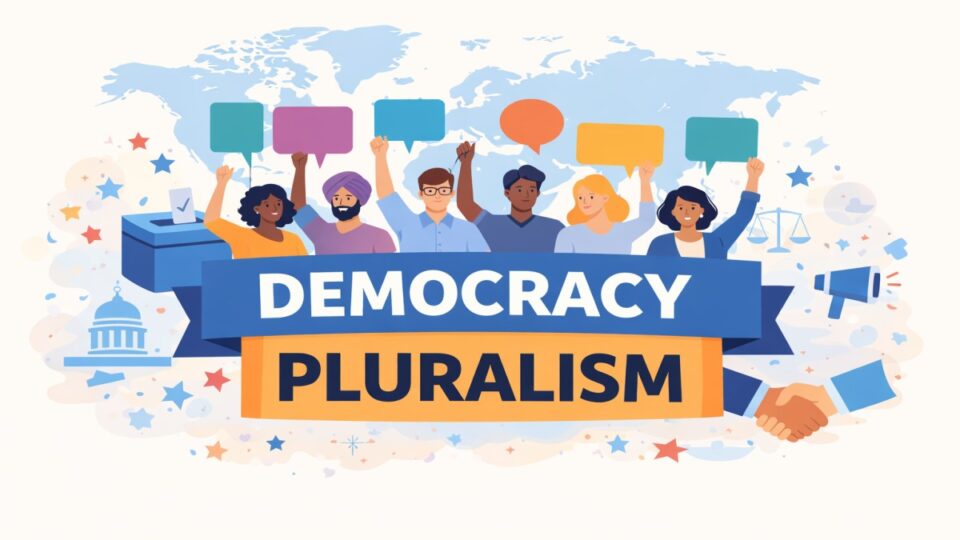
Democracy and Pluralism. In a world full of different beliefs, cultures, languages, and lifestyles, one question keeps coming back: how can people who are so different live together peacefully and fairly? The answer lies in the powerful partnership between democracy and pluralism.
Democracy gives people a voice. Pluralism makes sure all those voices—especially minority ones—are heard, respected, and protected. Together, they form the foundation of modern, inclusive societies.
Let’s explore how democracy and pluralism work, why they need each other, and what happens when one is missing.
What Is Democracy?
At its heart, democracy means rule by the people. Citizens participate in shaping laws, choosing leaders, and deciding the future of their country.
Key Features of Democracy
- Free and fair elections
- Freedom of speech and expression
- Independent courts
- Equal rights before the law
- Accountability of leaders
Democracy is not just about voting every few years—it’s about daily participation in civic life.
What Is Pluralism?
Pluralism is the recognition and acceptance of diversity within society. It celebrates the idea that people can belong to different groups—religious, ethnic, political, or cultural—and still share a common political system.
Key Aspects of Pluralism
- Respect for minority rights
- Tolerance of different beliefs
- Multiple political parties and opinions
- Cultural and religious freedom
- Power shared among many groups
Pluralism doesn’t mean everyone agrees. It means disagreements are handled peacefully and fairly.
How Democracy and Pluralism Work Together
Democracy without pluralism becomes majority tyranny—where the largest group controls everything.
Pluralism without democracy becomes fragmented chaos—where no one has a legitimate way to make decisions.
Together, they create balance:
| Democracy | Pluralism |
|---|---|
| Ensures people choose leaders | Ensures all groups are represented |
| Gives power to the majority | Protects minorities |
| Promotes participation | Promotes inclusion |
It’s like a choir—democracy sets the rhythm, pluralism brings in harmony.
Why Pluralism Is Essential for Democracy
Without pluralism, democracy turns into a numbers game. The biggest group always wins, and smaller communities feel ignored or oppressed.
Pluralism ensures:
- Fair representation of minorities
- Stronger social trust
- Less political violence
- More creative policy solutions
When people feel included, they protect the system instead of fighting it.
Forms of Pluralism in Democratic Societies
1. Political Pluralism
Multiple political parties compete for power. No single party dominates forever.
2. Cultural Pluralism
Different traditions, languages, and customs coexist without losing identity.
3. Religious Pluralism
People practice different religions freely under the same law.
4. Media Pluralism
Multiple news outlets present different perspectives, preventing propaganda.
Benefits of Democracy with Pluralism
- Reduces discrimination
- Builds social cohesion
- Encourages innovation
- Strengthens national unity
- Increases political stability
A society that listens to everyone stands stronger than one that silences many.
Challenges to Democracy and Pluralism
Populism
Populist leaders often claim to speak for “real people” while excluding others.
Fake News
Misinformation weakens trust and fuels hatred.
Economic Inequality
When wealth concentrates, political power follows.
Cultural Polarization
Communities retreat into isolated groups, refusing dialogue.
These challenges don’t destroy democracy overnight—but they slowly weaken its foundations.
What Happens When Pluralism Fails?
History shows us the danger:
- Minorities lose rights
- Violence increases
- Institutions collapse
- Trust disappears
When people feel invisible, they stop believing in democracy.
Strengthening Democracy Through Pluralism
To protect both, societies must:
- Teach civic education
- Promote independent journalism
- Protect free speech and minority rights
- Encourage dialogue between communities
- Ensure fair economic opportunities
Democracy isn’t inherited—it’s maintained.
The Role of Citizens
Pluralism doesn’t live in constitutions alone—it lives in everyday behavior:
- Listening before judging
- Voting responsibly
- Respecting differences
- Speaking out against injustice
Every citizen becomes a guardian of democracy.
Conclusion
Democracy gives us the right to choose. Pluralism gives us the right to belong. Together, they form a system where power is shared, voices are valued, and differences are seen as strengths—not threats.
A society that embraces democracy and pluralism doesn’t just survive—it thrives.
FAQs
1. Can democracy exist without pluralism?
Technically yes, but it becomes unfair and unstable over time.
2. Is pluralism the same as multiculturalism?
Not exactly. Multiculturalism focuses on culture, while pluralism includes politics, religion, and power-sharing.
3. Why are minority rights important in democracy?
Because democracy isn’t just majority rule—it’s rule with justice.
4. How does education support pluralism?
By teaching respect, history, and critical thinking.
5. Can pluralism weaken national identity?
No. It strengthens it by uniting people through.
