
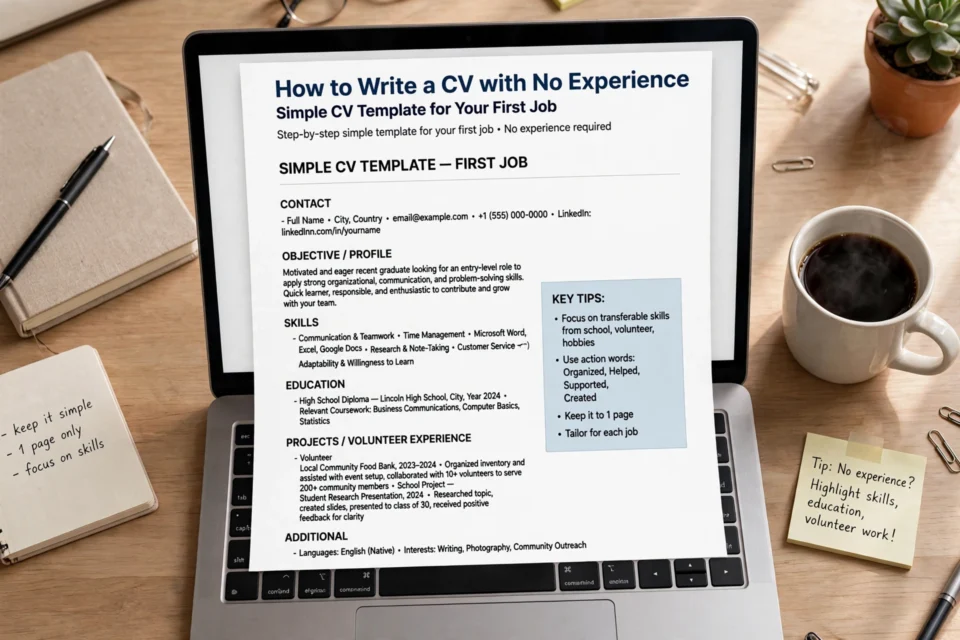
Learning how to write a CV with no experience can feel like a difficult first step. Many first-job adverts ask for experience, yet every working person started somewhere, and employers hiring for entry-level roles know that. A good first CV does not need a long work history. It needs to show, clearly and honestly, who you are, what you can do, and why you are ready to learn.
A CV is simply a short summary of your education, skills, and any useful experience, on one or two pages. This guide walks through a simple structure you can use, even if this is your very first application.
What employers look for in a first CV
For a first job, employers are usually looking for reliability, a willingness to learn, and basic skills they can build on. They want to see that you can turn up on time, follow instructions, communicate clearly, and work with other people. School projects, volunteering, part-time work, sports teams, and caring responsibilities can all show these qualities, even when they were not paid jobs. Be honest about what you have done, and focus on what you learned from it.
Start with a simple CV structure
A simple cv template for beginners usually follows this order: your name and contact details, a short personal statement, your skills, your education, any experience (including unpaid work and projects), and any extra information such as languages or interests that are relevant to the job. Keep it to one page if you can, and two pages at most. Use clear headings, short bullet points, and the same layout throughout, so it is easy to read at a glance.
Write a short personal statement
Learning how to write a personal statement for a cv is easier when you keep it to two or three sentences. Say what kind of role you are looking for, what strengths you bring, and what you hope to learn. For example, a school leaver might write that they are a reliable, organised student looking for a first part-time role, with strong communication skills from group projects and volunteering. Adapt the statement for each job, so it matches the role you are applying for, and avoid copying the same generic paragraph for every application.
Show experience you already have
This is the key part of a cv for students with no experience. List school or college projects, volunteering, internships, freelance tasks, part-time jobs, and clubs or teams, with a short line about what you did in each one. Instead of only naming the activity, explain the result: what you organised, helped with, or completed. If you are building a skill for your future career, such as learning a new language, mention it honestly as a skill in progress — see the site’s guide How to Learn a New Language at Home: A Simple Daily Routine for Beginners. Even a small project counts if it shows responsibility and follow-through.
What to include in a cv for a first job
When deciding what to include in a cv for first job applications, keep only what helps the employer judge your fit for that role. Include your education and grades or expected grades, relevant skills such as computer skills, languages, teamwork, and customer service, and any experience described above. Leave out unrelated hobbies, personal details such as your full address or date of birth, and long paragraphs. If a skill is listed, be ready to give a brief example of it in an interview.
Tailor your CV for each job
One of the most useful first job cv tips is to tailor your CV for each application. Read the job description carefully, note the skills it asks for, and bring the matching skills and examples to the top of your CV. Use similar words to the advert where they are true for you, but do not claim skills you do not have. A short, focused CV that matches one job is stronger than a long, general CV sent to many jobs unchanged. Save a copy for each application, so you remember what you sent.
Common mistakes to avoid
Avoid spelling mistakes, inconsistent dates, and vague claims with no example. Do not copy a CV from the internet without changing it to fit your own history, and do not use a photo or design that distracts from the content unless the job asks for one. Check every phone number and email address, use a simple professional email address, and ask someone you trust to read the CV once before you send it. A careful final check often catches small errors that are easy to miss.
Writing your first CV is a skill in itself, and it gets easier with each application. Start with a simple structure, describe honestly what you have already done, and tailor it to the job in front of you. You do not need years of experience to make a good first impression — you need a clear, honest CV that shows you are ready to learn and ready to work.
