
If your shower has slowly turned into a weak trickle, the problem is probably not your water pressure. It is limescale. Hard water leaves behind calcium carbonate, a white, crusty mineral that builds up inside the tiny holes of your shower head and blocks the flow. Learning how to clean a shower head with vinegar is the simplest fix for this, because the acetic acid in white vinegar dissolves limescale without harsh chemicals or expensive cleaners. All you need is a bottle of white vinegar, a sturdy plastic bag, and a little patience.
Why Limescale Builds Up on a Shower Head
Every time hard water passes through your shower head and dries, it leaves a small amount of mineral behind. At first you will not notice it, but over weeks and months those deposits grow. The spray becomes uneven, some holes stop working altogether, and the pressure feels much weaker than it used to be. You may also see white or greenish crust around the nozzles. This is normal in hard-water homes, and it does not mean your shower head is broken. A regular vinegar soak keeps it clear, and it is far cheaper than replacing the fitting.
What You Need to Clean a Shower Head with Vinegar
You do not need any special equipment for this job. Gather these things before you start: white vinegar (distilled white vinegar, about 5% acetic acid, works best); a sturdy plastic bag, large enough to fit over the shower head; a rubber band, hair tie, or piece of string; an old toothbrush or a soft scrubbing brush; a pin or a toothpick for stubborn holes; a clean cloth and a towel. Use white vinegar rather than malt or apple cider vinegar, because the clear liquid will not stain the fitting. Do not use bleach for this job: bleach does not dissolve limescale, and you must never mix vinegar with bleach, as the mixture gives off harmful chlorine gas.
How to Clean a Shower Head with Vinegar Step by Step
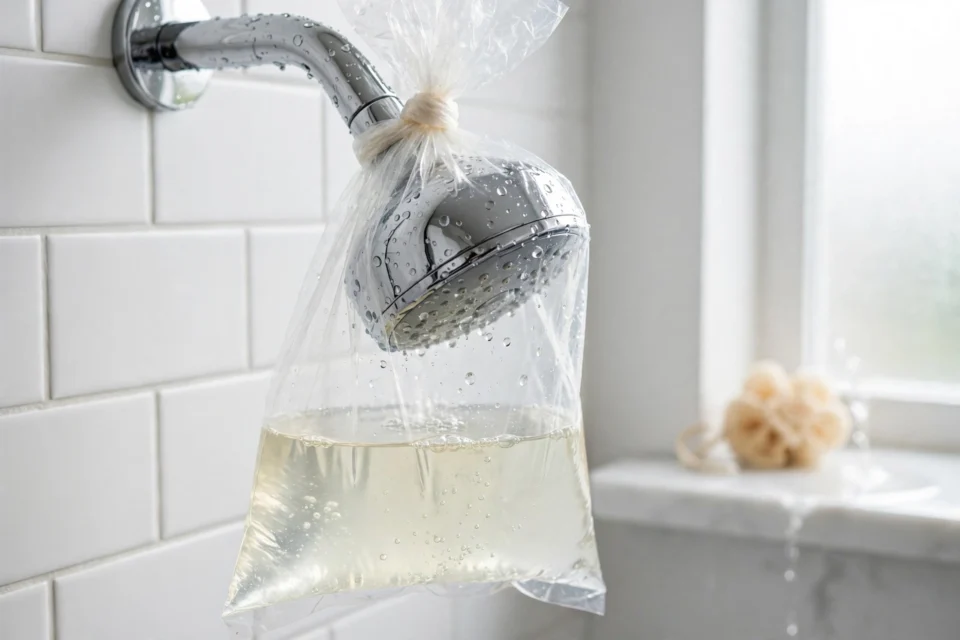
- Fill the bag with vinegar. Pour enough white vinegar into the plastic bag to cover the face of the shower head completely. For light build-up, you can dilute it with an equal amount of water. For heavy, crusty limescale, use undiluted vinegar, which works faster.
- Fix the bag over the shower head. Slide the bag up over the shower head so that every nozzle sits under the liquid, then gather the opening around the shower arm and tie it tightly with a rubber band or string. Make sure the bag cannot slip off: a bag full of vinegar is heavy, and a loose band will let it drop.
- Leave it to soak. Leave the shower head to soak for at least 30 minutes. For moderate build-up, one to two hours is better, and for heavy crust, leave it overnight, about six to eight hours. The acetic acid needs time to break down the mineral deposits, so do not rush this step. If your shower head unscrews easily, you can remove it instead and soak it in a bowl of vinegar, which works just as well.
- Remove the bag and rinse with hot water. Take the bag off carefully and tip the vinegar down the drain. Then turn the shower on hot and let the water run for two to three minutes. This flushes out the dissolved limescale and any loose flakes from inside the nozzles.
- Scrub the nozzles and clear blocked holes. Use an old toothbrush to gently scrub the face of the shower head, and rub the rubber nozzles with your thumb, which often pops soft scale straight off. If a hole is still blocked, poke it gently with a pin or toothpick. Rinse once more, wipe the head dry with a clean cloth, and your shower should spray evenly again.
How to Descale a Shower Head with Baking Soda
If the limescale is very stubborn, you can add baking soda to the vinegar soak. Mix about a third of a cup of baking soda with one cup of white vinegar in the bag, over the sink or in the bath, because the mixture will fizz. The fizzing helps lift the deposits from the surface. Secure the bag as before and leave it to soak overnight, then scrub and rinse as above. This is a useful option when a plain vinegar soak has not fully cleared the holes.
How to Clean a Shower Head Without Vinegar
If you have no vinegar at home, there are other ways to descale a shower head. Citric acid dissolved in warm water works in a similar way, and lemon juice can help with light build-up, although it is weaker than vinegar. Lemon is handy for other natural cleaning jobs too — see our guide on how to clean a microwave with lemon. A commercial limescale remover will also work, but follow the instructions on the bottle and rinse well afterwards. Whatever you use, check the manufacturer’s care guide first: some finishes, such as brass or certain plated coatings, should not be treated with acidic cleaners, and a shorter, weaker soak is safer for them.
How Often Should You Clean a Shower Head?
A quick 30-minute vinegar soak every one to three months is enough to stop limescale from building up into a real blockage. In very hard-water areas, clean it monthly. It is much easier to keep on top of the problem with a short, regular soak than to rescue a badly clogged head once a year. While you are at it, wipe the shower head dry after your shower now and then, and keep an eye on the spray pattern: if it starts to go uneven, that is your sign to descale it.
Mistakes to Avoid When Cleaning a Shower Head
A few simple mistakes can undo the good work. Do not use an abrasive scourer or a wire brush on the face of the shower head, because it will scratch the finish. Do not leave vinegar soaking for days on end, especially on delicate finishes, as long exposure to acid can dull the coating. Do not pour boiling vinegar into the bag, and do not forget to rinse the head well before your next shower, or the first spray will smell strongly of vinegar. Finally, do not ignore a shower head that stays blocked after two good soaks: the problem may be inside the fitting, and it may be time to replace the washer or the head itself.
Conclusion
Knowing how to clean a shower head with vinegar turns a frustrating, weak shower back into a strong, even spray in under an hour of mostly hands-off work. A bag, some white vinegar, and a soak of 30 minutes to overnight is all it takes to dissolve the limescale that hard water leaves behind. Make it a small habit every month or two, and you will keep your shower flowing well without buying a single special cleaner.
