
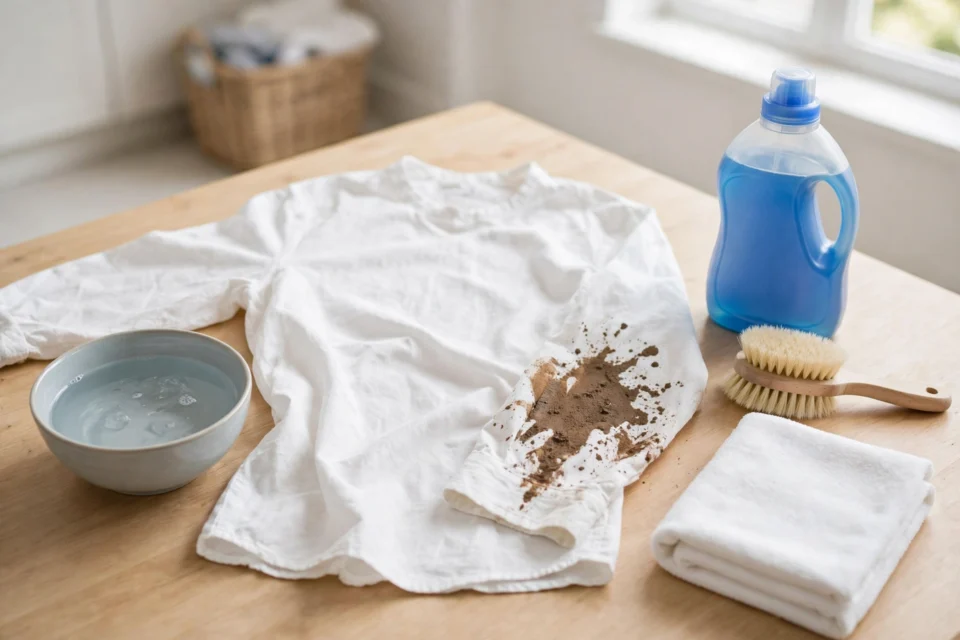
Mud on a favourite shirt, a pair of jeans or a school jumper feels like the end of that garment — but it is one of the most forgiving stains in the laundry basket, as long as you resist the urge to deal with it straight away. The secret of how to remove mud stains from clothes is counter-intuitive: do nothing first. Let the mud dry completely, brush it off, and only then bring in water and detergent. This guide covers the full method, plus white clothes, jeans, and stains already through the wash.
Why Mud Stains Need a Different First Step
Most stains reward fast action. Mud punishes it. Wet mud is fine clay, silt and organic matter in water, and while it is wet those tiny particles slide easily between the fibres. Rub it, rinse it or scrub it while it is still damp and you push the clay deeper into the weave, where it dries into a brown shadow that is far harder to shift.
Dry mud behaves completely differently. As the water evaporates, the clay shrinks and cracks into a brittle crust sitting on the surface of the fabric. A brush lifts that crust away in flakes — most of the stain mass, often around 80 to 90 percent of it, comes off before a single drop of water touches the garment. That is why waiting matters more than any product you buy. If you only remember one thing about how to get mud out of clothes, remember this: dry first, treat second.
What You Will Need
You do not need a special stain remover. Gather these before you start:
- A soft-bristle brush — an old toothbrush, a clothes brush or a clean vegetable brush
- Liquid laundry detergent, ideally one with enzymes
- A basin or sink with cold water
- A clean white cloth
- Oxygen bleach, for stubborn marks on fabrics whose care label allows it
- A bin or an outdoor spot, for brushing off the dried mud
Check the care label before you begin. It decides the highest safe wash temperature and whether oxygen bleach is allowed, and both matter later in this guide.
How to Remove Mud Stains from Clothes in 6 Steps
Work through these steps in order. The whole job takes two to three hours from start to finish, but most of that is drying time — the active work is about twenty minutes.
Step 1: Let the Mud Dry Completely
Lay the garment flat in a warm, ventilated spot and leave it alone. In warm, dry conditions mud usually dries in one to two hours; in cool or damp conditions, allow four to six hours. The mud is ready when it feels dry and crumbly to the touch.
Do not speed this up with a hairdryer, a radiator or direct sunlight. Forced heat can bake the clay particles onto the fibres, and sunlight can fade the fabric around the stain.
Step 2: Brush Off the Dried Mud
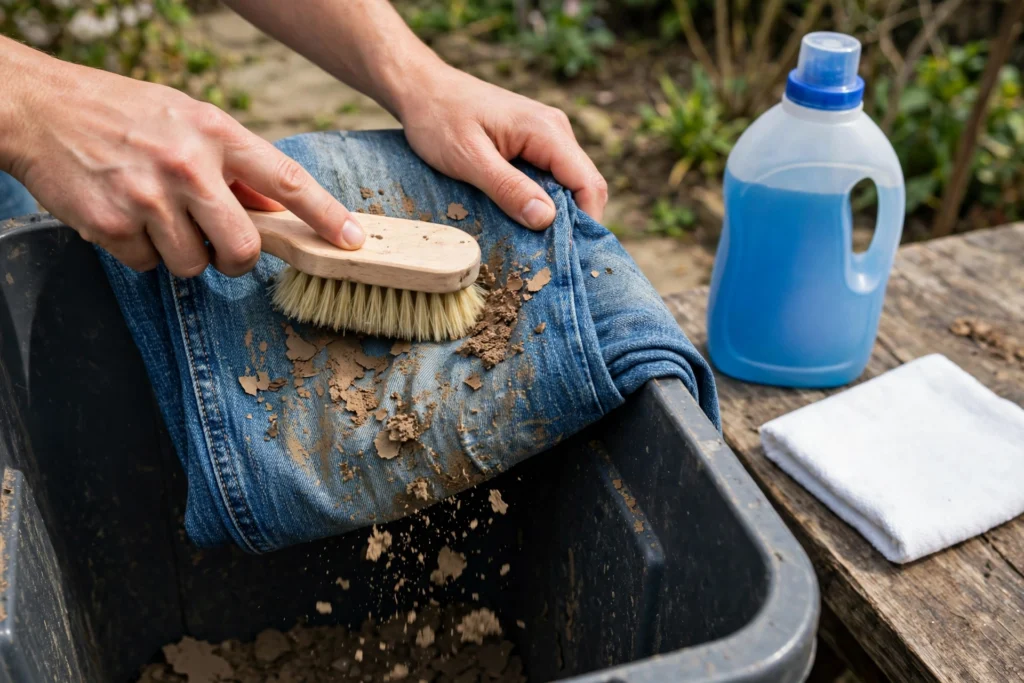
Take the garment outside or hold it over a bin. Brush briskly in one direction, working from the edges of the stain towards the centre so you do not spread loose dirt onto clean fabric. An old toothbrush works well for cuffs, collars and seams.
You should see flakes of dried mud falling away and the brown mark fading to a faint shadow. For muddy jeans, brush the denim firmly — sturdy cotton can take it — but use a lighter touch on knits, where hard brushing can lift the fibres and cause pilling.
Step 3: Pre-Treat With Liquid Detergent
Apply liquid detergent directly onto whatever mark remains. Enzyme detergents work best here, because their enzymes break down the organic part of mud — the decaying plant matter and tannins that brushing cannot remove — while the detergent lifts the remaining clay.
Rub the detergent in gently with your fingers or a soft toothbrush, then leave it to sit for at least 30 minutes at room temperature. Enzyme activity is time-dependent, so do not rush this step.
Step 4: Rinse in Cold Water
Rinse the pre-treated area under cold running water, working the fabric gently with your fingers. The cold rinse carries away the loosened clay and the detergent holding it. If a brown shadow is still visible after rinsing, repeat the pre-treatment once more rather than moving on.
Step 5: Wash at the Highest Safe Temperature
Wash the garment at the highest temperature the care label allows, on a normal or heavy-duty cycle. The mechanical action of the wash drum, combined with the enzyme pre-treatment, lifts and suspends whatever staining compounds are left. When in doubt, follow the label rather than guessing.
Step 6: Check Before Drying
Take the garment out and inspect the stain in good light before it goes anywhere near a tumble dryer. If the mark is gone, dry it as normal. If a faint shadow remains, do not dry it — dryer heat sets the remaining residue permanently. Instead, soak it in oxygen bleach solution for one to two hours (if the label allows it) or repeat the pre-treatment, then wash again.
How to Remove Mud Stains from White Clothes
White cotton is the most forgiving fabric for mud, because you can use every tool in the kit. Follow the six steps above, then, if a brown shadow survives the first wash, soak the garment in oxygen bleach solution for one to two hours before washing again. Oxygen bleach is gentler than chlorine bleach and safe on most whites, but check the care label first.
Two rules still apply on white: never use chlorine bleach unless the label clearly allows it, since it can yellow whites and weaken the fibres, and never put the garment in the dryer until the stain is gone. For keeping the rest of your whites bright once the stain is out, see our guide on how to keep white clothes white.
Mud on Jeans, Shoes and Carpet
The dry-first method works beyond shirts and jumpers, with small adjustments for each surface.
Jeans and denim. Sturdy cotton handles the full method well: let the mud dry, brush firmly, pre-treat with enzyme detergent for 30 minutes, then wash at the highest temperature the label allows. Turn jeans inside out for the wash to protect the colour, and expect a second wash for heavy ground-in mud on the knees.
Shoes. Let mud dry on trainers and canvas shoes, then brush it off outdoors and wipe the remaining marks with a cloth dampened with cold water and a little detergent. Do not machine-wash shoes unless the manufacturer allows it. For leather, brush off the dried mud, wipe with a barely damp cloth, and condition once dry.
Carpet and upholstery. The same principle applies: let the mud dry completely, then vacuum up the flakes before any liquid touches the carpet. Blot the remaining mark with cold water and a little detergent, working from the outside in, and blot — never rub — so you do not spread the stain or push it into the pile.
What Does Not Work on Mud Stains
A few common instincts make mud stains worse:
- Treating wet mud. Rinsing or scrubbing wet mud drives clay deeper into the fibres — always dry first.
- Scrubbing hard. Aggressive rubbing spreads the stain and frays the fabric. Brush dried mud firmly, but treat the remaining mark gently.
- The tumble dryer. Drying a garment before the stain is fully gone sets the residue with heat — check in good light first.
- Chlorine bleach on colours. It strips dye and can leave a worse mark than the mud. Oxygen bleach is safer, and only when the label allows it.
- Skipping the care label. Delicate fabrics have their own rules — guessing can ruin a garment a gentler method would have saved.
Mud is an outdoor stain, and outdoor stains share habits: grass stains also need pre-treatment before washing, while chocolate stains and blood stains need cold water first for different reasons. Sweat marks behave differently again — they yellow rather than set with heat, as explained in sweat stains on white shirts.
When to Take It to a Professional
Take the garment to a dry cleaner instead if it is silk, wool, leather, or labelled dry-clean-only, if it is valuable or sentimental, or if the stain covers a large area. Tell the cleaner what the stain is and what you have already tried.
Frequently Asked Questions
Can mud stains come out after the clothes have been washed?
Often, yes — if it was washed cold and air-dried, the dry, brush, pre-treat and wash method still works. If it was washed hot or tumble-dried with the stain in it, try an oxygen bleach soak, but expect only partial success.
Should you wash mud stains in hot or cold water?
Cold water for the rinse after pre-treatment, then the highest temperature the care label allows for the main wash. What matters is the order: dry and brush first, and never use the dryer until the stain is gone.
How to get mud stains out of white clothes?
Follow the same six steps, then soak the garment in oxygen bleach solution for one to two hours before washing again. Most mud marks come out completely. Never use chlorine bleach unless the care label clearly allows it.
Does mud come out of jeans easily?
Usually, yes. Denim is sturdy cotton, so it handles firm brushing, a 30-minute enzyme pre-treatment and a warm wash without damage. Heavy ground-in mud on the knees may need a second round of pre-treatment and washing, but it rarely survives both.
How long does mud take to dry on clothes?
One to two hours in warm, dry conditions, or four to six hours in cool or damp conditions. The mud is ready when it feels dry and crumbly. Never use a hairdryer or radiator to speed it up.
Conclusion
Learning how to remove mud stains from clothes comes down to one counter-intuitive rule: do nothing first. Let the mud dry, brush off the crust, pre-treat with enzyme detergent for 30 minutes, and wash at the highest safe temperature — then check before the dryer. Most mud stains come out completely with patience; the ones that survive were usually scrubbed wet or dried with heat too soon.
Sources: TextileTuts mud-stain guide; American Cleaning Institute stain-removal guidance.
